
How to Prevent Death or Harm From Medical Errors
Medical errors are responsible for an estimated 828,000 annual deaths among Americans, resulting from diagnostic mistakes, harm related to hospital care, adverse drug reactions, and hospital-acquired infections. This estimate does not include hundreds of thousands more deaths that occur after hospital discharge or during outpatient care.
For comparison, there were a total of 6,335 motorcycle fatalities in the United States in 2023 [link]. With numbers like that, you are 131 times safer [828,000 / 6,335 = 131] riding a motorcycle on public roads than being treated in a hospital.
It's easy to think that I am dramatizing the situation to attract your attention at the expense of hard-working doctors and nurses who are saving countless lives, but I am certainly not.
All the numbers cited on this page came from mainstream academic research published in the most discerning and prestigious medical journals.
For example, consider the following quote from a recent article by the team of researchers from the Department of Epidemiology at Johns Hopkins University Bloomberg School of Public Health [link]:
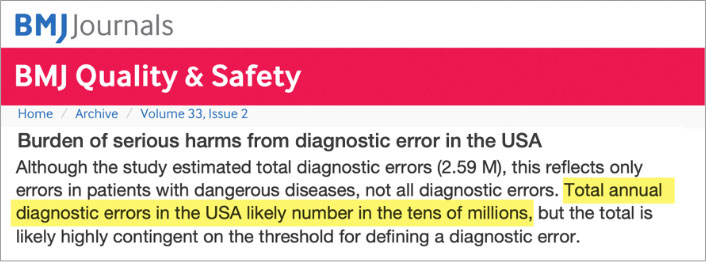
What I also find curious (and revealing) about this article is that it wasn't published in The New England Journal of Medicine or The Journal of the American Medical Association but in The BMJ Quality & Safety Journal, a division of the British Medical Journal and The Health Foundation [link]. Apparently, this material was "too hot" for leading American academic publications to handle.
With that in mind, let's dig into the numbers, and, even more important, into what you can do to prevent medical errors from ruining your own life because in a system so prone to errors, anyone could become a victim following a minor injury, infection, food poisoning, childbirth, elective surgery, or medical screening, regardless of your age, health, or income.
Hospitalization-Related Mortality
The 828,000 deaths estimate comes from the peer-reviewed studies published in major medical journals and by the U.S. Centers for Disease Control and Prevention:
371,000 Deaths From Diagnostic Errors:
"This manuscript provides the first robust, national annual US estimate for serious misdiagnosis-related harms (nearly 800,000 combined deaths (~371,000) or permanent disabilities (~424,000) across care settings (ambulatory clinic, emergency department, and inpatient)."
Newman-Toker DE, Nassery N, Schaffer AC, et al.Burden of serious harms from diagnostic error in the USA. BMJ Quality & Safety 2024;33:109-120.
https://qualitysafety.bmj.com/content/33/2/109
210,000 Deaths From Patient Harms Associated with Hospital Care:
"Using a weighted average of the 4 studies, a lower limit of 210,000 deaths per year was associated with preventable harm in hospitals. [...] The true number of premature deaths associated with preventable harm to patients was estimated at more than 400,000 per year. Serious harm seems to be 10- to 20-fold more common than lethal harm."
James, John T. A new, evidence-based estimate of patient harms associated with hospital care. Journal of patient safety vol. 9,3 (2013): 122-8. doi:10.1097/PTS.0b013e3182948a69
https://pubmed.ncbi.nlm.nih.gov/23860193/
175,000 Deaths From Adverse Drug Reactions:
"The most robust database of ADRs available is the U.S. Food and Drug Administration's Adverse Event Reporting System (FAERS). In 2022, there were over 1.25 million serious adverse events reported and nearly 175,000 deaths."
Kommu S, Carter C, Whitfield P. Adverse Drug Reactions. [Updated 2024 Jan 10]. StatPearls Publishing.
https://www.ncbi.nlm.nih.gov/books/NBK599521/
72,000 Deaths From Hospital-Acquired Infections:
"There were an estimated 687,000 HAIs (Hospital-Acquired Infections) in U.S. acute care hospitals in 2015. About 72,000 hospital patients with HAIs died during their hospitalizations."
HAIs: Reports and Data, U.S. Centers for Disease Control and Prevention
https://www.cdc.gov
To summarize, the total number of deaths related to these four causes is calculated as: 371,000 + 210,000 + 175,000 + 72,000 = 828,000. The total represents the lowest published estimate for each cause.
Since the estimates for each cause of death come from different studies and time periods, some overlap between categories is inevitable, and the actual total number might be smaller. Still, even when interpreted conservatively, these numbers indicate a level of harm that surpasses all other causes of death in the United States.
For comparison, the 828,000 number is greater than the number of annual deaths from heart disease (680,981), cancers (613,352), accidents (222,698), and strokes (162,639), and makes medical errors the number one cause of death in the United States. [Source: National Center for Health Statistics]
But that's only half the story — the risks of medical errors from routine medical care start well before any possible hospitalization and are equally significant:
Harms Related to Outpatient Care
Seeing a family doctor or a specialist is also a risky endeavor. Below are selected summaries from recent publications on this subject:
"A large national analysis of ambulatory adverse drug events (ADEs) estimated about 4.5 million ambulatory visits per year related to ADEs, with roughly 400,000 of those visits leading to hospitalization; this is drug‑related harm alone and does not include other outpatient error types."
Sarkar U, López A, Maselli JH, Gonzales R. Adverse drug events in U.S. adult ambulatory medical care. Health Serv Res. 2011 Oct;46(5):1517-33. doi: 10.1111/j.1475-6773.2011.01269.x. Epub 2011 May 10. PMID: 21554271; PMCID: PMC3168717.
"A study extrapolating from Colorado and Utah data estimated that outpatient preventable adverse events lead to about 75,000 hospitalizations annually in the US, resulting in approximately 4,839 serious permanent injuries and 2,587 deaths; roughly 10% of preventable outpatient events caused serious permanent injury or death."
Woods DM, Thomas EJ, Holl JL, Weiss KB, Brennan TA. Ambulatory care adverse events and preventable adverse events leading to a hospital admission. Qual Saf Health Care. 2007 Apr;16(2):127-31. doi: 10.1136/qshc. 2006.021147. PMID: 17403759; PMCID: PMC2653165.
"A 2024 Massachusetts record‑review study ("The Safety of Outpatient Health Care") found that 7% of patients experienced at least one adverse event in outpatient care, 17.4% were serious, and 2.1% were life‑threatening; about 64% were medication‑related, and the authors emphasized that events were likely undercounted."
The Risk Management Foundation of the Harvard Medical Institutions Incorporated. Study Highlights Need for Improvement of Patient Safety in Outpatient Settings. May 06, 2024. https://www.rmf.harvard.edu/News-and-Blog/Press-Releases-Home/Press-Releases/2024/May/SafeCare-Study-Outpatient
Unlike hospitals, outpatient clinics do not track or report medical errors. As a result, the statistics above reflect only a fraction of the actual harm. Nonetheless, the trend clearly shows that outpatient care accounts for a significant portion of total deaths and medical harm.
The cumulative risks of hospital and outpatient care are multiplied by having borderline nutritional deficiencies, overhydration, functional metabolic, respiratory, and digestive disorders, regular use of prescription and OTC medications, alcohol consumption, smoking or vaping, annual physicals, exposure to x-ray radiation, high-risk activities such as injury-prone sports, overexercising, weight loss diets, eating disorders, being underweight or overweight, insomnia, mental/emotional disorders, chronic pain, poor dental care, and any other conditions that require ongoing interaction with healthcare providers.
The partial list above refers to adults of any age who consider themselves "healthy" by conventional standards. The risks are even higher for people with chronic cardiovascular, autoimmune, neurological, genitourinary, and endocrine disorders that require ongoing medication.
Artificial Intelligence Will Increase the Risk of Medical Errors
The AI-assisted healthcare will only increase overtreatment and overprescription because it inherits the workflows and financial incentives of the healthcare system that deploys it in the first place.
-
AI reinforces existing treatment protocols. The models are trained to replicate and follow a well-established pattern of care. It may prevent many errors with more proactive monitoring, but it will not fundamentally change the delivery of care.
-
AI is tied to billing and risk scoring. If the financial model rewards more monitoring, more prescriptions, or lower thresholds for disease classification, AI will push care in that direction.
-
Liability concerns will incentivize overtreatment. AI tools can identify hundreds of micro-anomalies that doctors may miss. In these situations, precautionary tests and prescriptions suggested by AI will become the safest treatment to follow. The likely result is more tests, more drugs, and more medical errors.
-
AI tools are optimized to achieve near-term clinical targets such as blood pressure thresholds, glucose ranges, or imaging abnormalities. When the objective goals reward short-term control, overtreatment becomes the default.
To summarize, in a system that already leans toward overtesting and overprescribing, AI will amplify those tendencies. On top of that, health systems will deploy AI to reduce staffing needs and will further increase systemic risks of medical errors, deaths, and injuries.
By no means does this conclusion mean that AI is inherently evil, but it simply reflects a well-established fact that any tool is as good as its user.
The Safest Medicine Is the One You Need the Least
Reversing and staying free of preventable chronic disorders is the only viable approach to prevent medical errors because it minimizes interactions with the healthcare system, eliminates dependence on lifestyle drugs, averts mental and physical decline, and lets you maintain full independence for life.
Not getting sick with lifestyle-related conditions that are behind the leading causes of death in the United States is the fastest, least expensive, and most reliable way to eliminate diagnostic and treatment errors. Here are the top four:
-
Heart disease: "Despite being largely preventable, cardiovascular disease (CVD) causes more than 20.5 million deaths every year. An estimated 80% of cardiovascular disease, including heart disease and stroke, is preventable." [World Heart Federation]
-
Strokes: "Approximately 80% of strokes could be prevented by screening for and addressing known risks with measures such as improving hypertension control, smoking cessation, diabetes prevention, cholesterol management, increasing use of anticoagulation for atrial fibrillation, and eliminating excessive alcohol consumption [Centers for Disease Control and Prevention]
-
Cancers: 94% of all cancers are non-genetic. They are attributable to modifiable environmental and lifestyle exposures, including diet, obesity, smoking, alcohol use, and chronic inflammation, rather than inherited mutations:
"Asians have been shown to have a 25 times lower incidence of prostate cancer and a ten times lower incidence of breast cancer than do residents of Western countries, and the rates for these cancers increase substantially after Asians migrate to the West." [Pharmaceutical Research: An Official Journal of the American Association of Pharmaceutical Scientists]
Wrap your head around this: a 25-fold lower incidence of prostate cancer and a 10-fold lower incidence of breast cancer. That is a striking difference simply associated with not living a Western lifestyle.
-
Diabetes. In adults, 5% to 10% of diabetes cases are type 1, so the majority of deaths in adults are presumed to be from type 2, which is driven by excess energy intake, fat accumulation, and physical inactivity. Long-term prevention and remission through dietary and lifestyle modifications are well documented:
"The good news is that prediabetes and type 2 diabetes are largely preventable. About 9 in 10 cases in the U.S. can be avoided by making lifestyle changes. These same changes can also lower the chances of developing heart disease and some cancers. The key to prevention can be boiled down to five words: Stay lean and stay active." [Harvard T.H. Chan School Of Public Health]
Pretty much the same goes for memory loss and cognitive decline due to Alzheimer's disease, kidney and liver disease, non-infectious gastrointestinal disorders, and all other lifestyle-related disorders.
I know this better than most because at 71, I don't have any of these conditions, and neither does my wife because for the last 28 years we have followed the lifestyle described on my site.
And it isn't like we started from a clean slate — I survived a bout with late-stage type 2 diabetes that peaked in 1998, and it led to my return to medicine and close to three decades of research and writing about these disorders.
If you aren't familiar with my work, you can learn about my journey here: Why Should You Trust Me?
Author's Note
It's terrifying! Instead of living longer and better, almost a million Americans are dying each year from preventable medical errors, and many more millions are getting hurt in the process. And I don't expect it to get any better anytime soon because the system that causes these deaths and harms is rewarded for the mayhem.
Take care of yourself and your families! All the information you need to survive 'the best medical care in the world' is right under your fingertips.
Good luck!