
Digestive disorders behind autism epidemic
According to the Centers for Disease Control and Prevention, “560,000 individuals between the ages of 0 to 21 have an ASD [autism spectrum disorders]”, and “between 1994 and 2004, the number of 6 to 17-year-old children classified as having an ASD in public special education programs increased from 22,664 to 193,637.”
That‘s an 850% increase in autism incidence in just 10 short years, while autism epidemic on this dramatic scale wasn‘t even on the radar just a generation ago. And here is, in part, why:
What Is The Connection Between Infant Constipation, Diarrhea, And Autism?
Greetings, My name is Konstantin Monastyrsky. I am an expert in forensic nutrition and the author of Gut Sense: How To Reverse and Prevent Constipation and Irregularity in Children and Adults. People often ask me this question: — Konstantin, what is the connection between infant constipation, diarrhea, and autism?
Quite direct, if you ask me… It usually starts [in otherwise healthy children — KM] from a simple bout with diarrhea, so common among infants and toddlers. After diarrhea strikes, pediatricians incorrectly recommend giving them solid food, as in this telling example from the website of a major university children‘s hospital [link]:
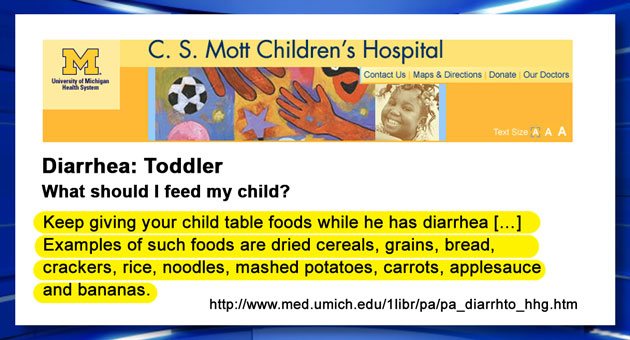
As luck has it, most children instinctively refuse food during the acute stages of diarrhea. However, if you force them to eat what‘s recommended by their doctors, the diarrhea usually gets much worse, and not just diarrhea.
That is because applesauce and bananas are both laxogenic foods. Their laxative effect comes from pectin and sorbitol — two nutrients well known for their prominent diarrheal effect.
Also, since all wheat products — cereals, bread, crackers, noodles — contain indigestible fiber, its fermentation inside the large intestine causes gas, bloating, and abdominal cramps. All along, the situation is made even worse by gluten — a hyper-allergenic wheat protein — because gluten commonly causes acute intestinal inflammation.
When all that becomes unbearable and life-threatening, doctors prescribe antibiotics to wipe out intestinal bacteria and stabilize the child. This tactic stops diarrhea and inflammation for a while, but causes constipation, because there are no innate bacteria left to form normal stools.
At this point, pediatricians routinely recommend adding fiber to “fix” constipation, as in this telling example from the Mayo Clinic web site [link]:
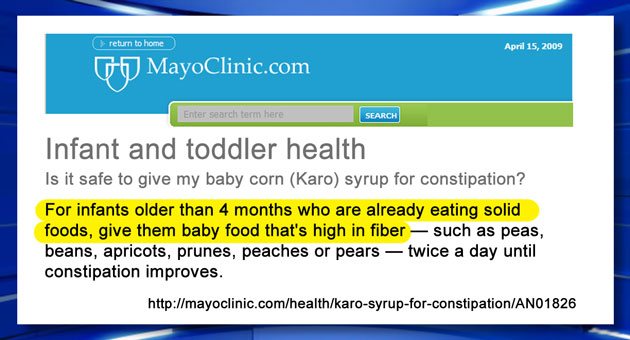
This novel treatment has been applied with vengeance over the last 20 or so years only in the United States. In the rest of the developed world dietary fiber always was and still is a big no-no in pediatric nutrition.
Since tiny infants and toddlers can‘t process gluten and dietary fiber as efficiently as full grown adults, they soon run into profuse diarrhea again, and this vicious cycle starts anew, causing even more severe intestinal inflammation, requiring even more antibiotics, and, consequently even more fiber to relieve constipation.
All along, because of the severe intestinal inflammation, the child can‘t resume a normal diet, and quickly becomes malnourished, making the treatment, feeding, and recovery even more challenging.
Because infants and toddlers have a very limited storage of essential nutrients inside their tiny bodies, malnutrition may happen literally in days, not weeks or months like with adults. The ensuing deficiency in folate, iron, essential fatty acids, and primary proteins quickly results in some or all symptoms of the autism spectrum disorders.
To learn more about the connection between the treatment of bowel disorders and autism, and what you can do to prevent this from happening to your child, please visit this page.
Good luck!
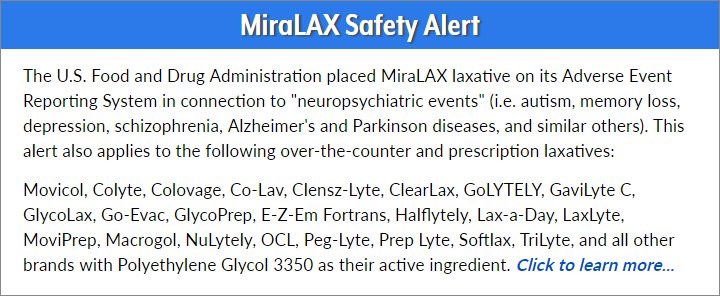
Q. You are not an expert in autism or pediatrics, but you are hurling out serious accusations at respected people in these fields. Do you have any proof of what you are saying?
My report is entitled “What Is The Connection Between Infant Constipation, Diarrhea, and Autism,” and has nothing to do with the treatment of autism, or with medical professionals involved in this field. If that's your perception of my report, read the transcript again.
I am an expert in forensic nutrition, and my report is a classical forensic analysis — relating to the investigation and establishment of evidence — of the etiology of postnatal (non-genetic, acquired) autism. I only discuss the chain of unfortunate clinical events that precede autism in the otherwise healthy infant. This chain of events can be presented as the following diagram:
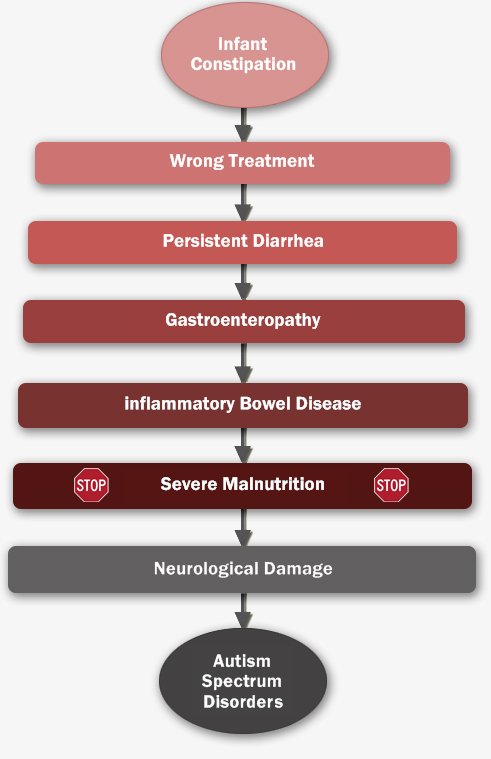
My report stops at the severe malnutrition stage. What happens after that stage is completely outside of my area of expertise (or, for that reason, of anyone involved into this field because past this stage most of the neurological damages are irreversible), and the core and essence of my report and message is this: if you don't want your otherwise healthy baby to suffer neurological damage from malnutrition caused by the incorrect treatment of constipation or diarrhea, don't allow this barbaric treatment to harm your child.
Anyone interpreting my report otherwise — as something having to do with autism therapy, or autism treatment, or autism genetics, or autism awareness, or what-have-you, is, apparently, in denial, or has an agenda other than the safety and welfare of your child.
And, now, here is your proof from the authors of The Merck Manual Of Diagnosis and Therapy. This is hardly a medical textbook written by my “admirers” or “supporters,” but the most dominant and archconservative medical textbook in the Western world and a “standard of care” reference for all American physicians. If that “proof” isn't good enough for you, take your challenge to Merck, not me:
"Etiology [of diarrhea]: Causes include gluten-induced enteropathy, cystic fibrosis, sugar malabsorption, and allergic gastroenteropathy." [link]
With the exception of cystic fibrosis, this quote mirrors my report word-by-word: gluten-induced enteropathy from wheat products (i.e. crackers, grains, bread, cereals); sugar malabsorption from sorbitol and pectin in applesauce and bananas; and allergic gastroenteropathy from all of the above.
And Merck echoes what I have been saying about infant malnutrition in general:
"Infants and children are particularly susceptible to undernutrition because of their high demand for energy and essential nutrients.” [link]
This brief essay — All That Goodness Gone To The Rats — contains additional insights into adult and pediatric malnutrition related to “healthy diet” doctrine.
So none of this is new, news, or revolutionary. These are all well-established medical facts, well past any debate or disagreement, unless out of spite. And all I am doing here and elsewhere — is connecting the dots. That's what the forensic nutrition is all about.
And if you still believe into the “vaccine theory” of autism, it was a lie all along: “For a decade, many parents have worried that vaccines might somehow be causing autism in children. Repeated assurances from respected experts that there is no link have failed to quiet those fears. Now The Lancet, a prestigious British medical journal that published the paper that first gave wide credence to those fears, has retracted it, saying that the paper‘s authors had made false claims about how the study was conducted. The journal acted after a British medical panel had found the lead author, Dr. Andrew Wakefield, guilty of dishonesty and flouting medical ethics.” (A Welcome Retraction; The New York Times; Feb 5, 2009 [link]).
Q. My doctor reviewed your report, and he told me that you are a lunatic...
Thank you! That's a compliment. In their days Dr. Semmelweis, and Dr. Marshall were also called lunatics, so I am honored to be in their distinguished company!
 A Hungarian physician Ignaz Philipp Semmelweis (1818 – 1865) was stripped of his medical license and confined to a psychiatric asylum in Vienna because he was urging European obstetricians to wash their hands in chlorine solution before prenatal examination and delivery in order to dramatically reduce (5 to 10 times) mortality among young mothers and their newborns.
Just 14 days after his confinement to the asylum, Dr. Semmelweis was found dead, apparently after being severely beaten by his guards. The poor doctor was only 47 years old and just as sane as you and I…
Dr. Barry Marshall (born 1951), our contemporary, had received along with Dr. Warren the 2005 Nobel Prize in medicine “for their discovery of the bacterium Helicobacter pylori and its role in gastritis and peptic ulcer disease.”
 Dr. Marshall's work was ignored and denigrated for years because it was cutting into the enormous profits of big Pharma, surgeons, and hospitals treating peptic ulcer-related complications. Back in the eighties and nineties, Tagamet became the first drug ever to reach more than $1 billion in annual sales. Along with its analogues — Zantac and Pepcid — these potent antacids became the highest selling drugs in the world.
Meanwhile, millions of people have been dying from bleeding ulcers and gastric cancers, even though a single course of antibiotics — not surgery or life-long prescription antacids — was all that was needed to wipe out this ulcer-causing infection once and for all.
To prove his point, Professor Marshall infected himself with H.pylori bacteria in 1984, and treated the subsequent gastric inflammation with a single course of antibiotic. It took another decade of ensuing publicity to stop the slaughter and get his views accepted by the mainstream medical establishment.
Since I am 55 [at the time of this writing in 2009 - ed.] — too old to become autistic to prove the point — I am resorting to the well-established medical facts, and letting you draw your own conclusions. That said, I don't believe for a second that any sane medical doctor in the United States would say anything like that after reviewing this page, and related links. Nonetheless, if that was your perception of what you think your doctor had meant, or, indeed, said, challenge him or her with the following simple questions:
— Doctor, it is against the law to recommend bulk-forming indigestible fiber for constipation. Konstantin didn‘t make that law — the U.S. Federal Drug Administration did. Why, then, are you recommending fiber to my child?
— Doctor, pectin in applesauce and sorbitol in bananas are both potent laxative agents, and are both contraindicated for acute diarrhea because they cause “sugar malabsorption.” Why, then, are you recommending bananas and applesauce to my child?
— Doctor, gluten in wheat cereals, bread, crackers, and noodles is a major digestive allergen, responsible for “gluten enteropathy” — a precursor to celiac disease, Crohn‘s disease, and ulcerative colitis. It is very harmful for a child with an already aggravated gut, and is a major source of food allergies among all children. Why, then, are you recommending gluten-containing products to my child?
— Doctor, dietary fiber incites intestinal fermentation, and causes gas, bloating and severe abdominal cramps in children and adults alike. Why would you recommend giving fiber to a super-sensitive infant or toddler who is already under tremendous duress from dehydration and diarrhea?
— Doctor, according to the pediatric section of The Merck Manual of Diagnosis and Therapy, the “standard of care” for children with severe diarrhea is “...requires [parenteral - Ed.] fluid and electrolyte replacement to correct dehydration, electrolyte imbalance, and acidosis. [link]” Your recommendations to give my child solid food and fiber while she is affected by severe diarrhea, are the complete opposite. Why?
And if all of these arguments fail, then simply take you child to another doctor. If you also wish to save other children from this naked negligence and malpractice, file your complaint with the state licensing board, inform the child protective services, notify your insurance company, tell other parents, and discuss this matter with your family‘s attorney. Nothing stops medial idiocy as swift as the chance of losing one's license, livelihood, and reputation.
Q. "ASD is not caused after birth!!!!! People who have it are born with it!!!!! Don't you understand that???"
This simplistic and virulent understanding of autism is based on the self-defeating precept alluded to by the Merck Manual of Diagnosis and Therapy:
“Autism Spectrum Disorders: The cause in most children is unknown, although evidence supports a genetic component; in some, autism may be caused by a medical condition.” [link]
But, then, in the same breath, Merck goes on to say exactly what I have been saying all along: "autism may be caused by a medical condition." That is what my report describes: the sequence of unfortunate medical conditions that precede neurological disorders that, in turn, eventually manifest themselves as ASD.
The genetic link is equally shaky, according to the CDC: “It is estimated that about 10% of children with an ASD have an identifiable genetic, neurologic or metabolic disorder, such as fragile X or Down syndrome [link].” In other words, only 0.1% of newborns are expected to be affected by autism due to 'bad genes' rather than about 1% (10 times more) as it is today.
That is why I strongly believe that looking at autism as simply a “child's problem,” оr “genetics,” or “unknown” is grossly irresponsible, particularly for physicians in this field and for parents who already have an autistic child, and may want to conceive another child.
Neurological development begins in the fetus, and how well it goes depends a great deal on the health of the prospective mother as well as her nutrition, mid-pregnancy medical treatment, environment, luck, and so on. That — the underlying health of “mothers to be,” and not genetics — is the reason why twins or consecutive children are often “born with autism.”
Besides maternal nutrition before and during the pregnancy, a myriad of bad things may happen between conception and delivery that may cause neurological damage to the fetus — physical trauma by a seat belt, salmonella or listeria poisoning in the restaurant, nutritional deficiency related to NVP (nausea and vomiting during pregnancy), a single tablet of aspirin, the side effects of antibiotics, second hand smoke, exposure to mercury in fish, herpes, HPV (human papillomavirus), elevated blood sugar levels related to gestational diabetes, elevated blood pressure, blood coagulation problems, the flu, and on, and on, and on...
Next, the quality of breast milk may be too low, and may eventually cause borderline malnutrition in the infant. This is how The Merck Manual of Diagnosis and Therapy describes this pathology:
“Infants fed only breast milk, which is typically low in vitamin D, are given supplemental vitamin D; they can develop vitamin B12 deficiency if the mother is a vegan. Inadequately fed infants and children are at risk of protein-energy under nutrition (PEU; previously called protein-energy malnutrition) and deficiencies of iron, folate (folic acid), vitamins A and C, copper, and zinc.” [link]
These factors are rarely (if ever) discussed or acknowledged in autism circles, but may explain why some healthy breastfed babies develop ASD without apparent signs of digestive distress, such as diarrhea.
Next, as I stated elsewhere, when malnutrition takes hold due to acute gastroenterocolitis (an inflammatory response to food-born allergens and fiber throughout the entire gastrointestinal tract that is manifested by acute diarrhea, or gastroenteropathy, as Merck calls it), the neurological damage may occur in as little as 5 to 10 days, particularly in children who are getting borderline-quality milk.
Q. My child has never had severe diarrhea or constipation, but is still affected by autism.
Infant undernutrition (related to constipation, diarrhea, poor quality breast milk, trauma, or what have you) is only one of the causes, and this is what I describe in my report. I also believe it is the dominant one, particularly among children who were born without any discernable signs of ASD.
Q. If what you describe is true, how come older children don't develop autism even after a prolonged case of diarrhea?
Neurological development takes places between conception and 36 months of life (the so called “nursing stage”). Since infants and toddlers have limited stores of essential nutrients, they require an uninterrupted supply of top-quality food (primarily breast milk or formula). Anything that disrupts this cycle for even one week may cause neurological damage.
Past the “nursing stage,” children are “wired in” for life. True, poor nutrition may result in lower IQ, stunted growth, and a myriad of other health problems, but it is less likely to cause post-natal neurological damage related to ASD.
Q. "My son was born with chronic constipation. he has always been that way. What would you say to me?"
I discuss infant and toddler constipation in these two videos: Why Is My Infant Constipated? and Why Is My Toddler Suddenly Constipated? The first video opens with the following statement:
“There are two types of constipation — functional and organic. So, first, ask your pediatrician to rule out obstruction, impaction, infection, or any other condition behind organic constipation.”
Though a child can't be “born with chronic constipation,” he or she can be affected by a congenital condition, such as Hirschsprung's disease or a birth defect that may be causing bowel obstruction, or affects the autonomous or central nervous system. These disorders, obviously, will manifest themselves as “chronic constipation.”
This in itself, has nothing to do with autism, except if these conditions aren't treated immediately, the ensuing impaction of feces in the obstructed colon will quickly cause an inflammatory condition throughout the entire GI tract. This condition will soon result in acute malnutrition, that, in turn, will cause near certain neurological damage that will eventually manifest itself as ASD.
If these congenital conditions and birth defects are missed, the fault is squarely with the obstetricians who are supposed to treat them immediately, rather than taking a laissez-faire attitude — Don't worry mum, a few days without stools is perfectly okay, as is often the case today!
Q. Other infants get diarrhea, sometimes prolonged, and they don't get autism. How do you explain that?
Diarrhea is the body's way of eliminating pathogens from the blood by dumping the blood plasma inside the colon, and from the GI tract by eliminating digestive fluids from inside the small and large intestine. These pathogens can be viruses, bacteria, soluble fiber, parasites, excess electrolytes, and numerous others.
When the large intestine is the only organ that is affected by diarrhea, the child will be fine as long as she keeps consuming breast milk, formula, or appropriate food because these are still getting assimilated inside the small intestine. In this case the risk of neurological damage isn't as profound, though still exists in cases of acute dehydration.
Then, there are situations when the child is affected by a condition called gastroenterocolitis, — or inflammation of the mucous membrane in the stomach, small intestine, and large intestine. In these cases, no matter what the child eats, it will get dumped out with either vomiting, diarrhea, or both.
In other words, simply “eating” isn't enough. Foods become “nutrients” not after they get swallowed, but after they get assimilated from the small intestine into the blood stream. This is precisely what I describe in my report as one of the probable factors behind acute malnutrition and ensuing neurological damage, even though, to all intent and purpose, the child is still eating.
What can be done in these situations to avert a disaster? Well, for starters, a child must be immediately and properly diagnosed by an experienced physician. Second, she should be taken to the pediatric hospital, and taken off all foods, so her GI tract is given time to heal. Third, and this is the most critical, all of his/her fluids and nutrients should be provided parenterally (via IV drip) for as long as the healing process takes place, usually 48 to 72 hours. Only after that should feeding be resumed, starting with fluids only.
This is axiomatic ‘old school...‘ I didn't invent anything new nor am I proposing some novel exotic treatment. Instead, children are force-fed with indigestible fiber and laxogenic foods and fluids, as I describe and illustrate in the video. This isn't a legitimate medical treatment, but “manslaughter!”
Q. When your report is discussed on the Internet forums, many parents of autistic children are very angry at you. They poke fun at your accent, call you a quack, an idiot, a profiteer, a schmuck, a lunatic, and so on. Why is that?
People are conditioned to believe what they wish to believe, so when someone else comes along, and forcefully tells them something that compromises their worldview, established groupthink, and belief system, they simply hate the messenger with the sadistic fervor of a lynching crowd. A kind of road rage, only without the physical violence.
There is, probably, a certain prejudice over my accent, unusual background, and ethnicity, but mainly among non-Americans. Here, in the States, I am always told that my accent is "charming," and that it makes me stand out, and not once in 30+ years have I experienced an act of overt ethnic hostility.
Also, I realize, that parents of autistic children are traumatized by their ordeal, and some may fall into what's known as “Stockholm Syndrome,” or a condition where the victim so identifies with his/her captors/perpetrators, that they begin to defend and justify them. Having your child affected by autism is definitely a “captive” and “perpetrating" experience.
Obviously, this whole phenomena of utter lack of civility and incredible rudeness on the Internet forums is something well known, and is expected.
Still, I feel a great deal of empathy for the children who can‘t respond on their own behalf, and any rudeness of their parents over my discourse isn‘t going to stop my work in this or any other field.
Furthermore, my report is about preventing the 850% growth in the incidence of autism from soon becoming 1600% growth. There is little I or anyone else can do for children who are already affected by autism, because, unfortunately, most of it is irreversible.
This is, incidentally, what is the most misunderstood aspect of my reporting — it isn't about treatment of autism as such, but about its prevention in otherwise healthy (at birth) children. A ‘sea‘ of a difference!
Q. Can the information on this site help my child if she is already affected by autism?
Yes, absolutely, you can learn a great deal from this site and from my books. This information may improve the physical condition of your child, avert further mental decline, and, perhaps, reverse some of the damage.
Considering the stresses you are under, it may also help you and your other children a great deal. And if you are planning to conceive another child, this is simply a MUST reading if you wish to prevent the reoccurrence of autism in the future siblings.
Do not expect, though, easy answers or quick-fix solutions. Unless you do your homework first, it isn‘t going to work. Furthermore, certain aspects of ASD and related disorders may not be reversible, particularly mental difficulties and autoimmune disorders, related to inflammatory conditions of the respiratory and digestive organs.
Still, don‘t defeat yourself by jumping to quick conclusions, such as “this is so simple, it can‘t be right.” Just look at the problems you are dealing with, and all of the complex and expensive “solutions” you have already tried, and evaluate the results. Did complex “solutions” solve your problems? If you are still reading this page, apparently they didn‘t!
So, please, suspend your negative thinking for a moment, and study the information on my site without bias. If you do, you and your child will be amply rewarded, otherwise don‘t even waste your time trying, because autism isn‘t just a neurological disorder affecting a child, but is also a “mental” disorder affecting parents, doctors, and society, who are all trying to solve a core development problem related to malnutrition with complex drug-based solutions based on the misunderstanding of the actual causes, that also happen to cause even more malnutrition.
Q. Konstantin, do you consult? I‘ll mortgage my house to pay you if you can save my child...
Thank you for your confidence in my expertise, and I would love to help you any way I can, but this (individual consulting) isn‘t going to work for the following reasons:
- First, I am not some kind of a “healer” with a magic bullet, quick fixes, and instant solutions under my sleeve. Treating digestive disorders related to autism is an extended, up-hill fight that requires continuous day-to-day guidance.
- Second, if you have the financial means to spare, start by secluding yourself in a hotel away from home for a few days, and study my site and my books uninterrupted. All of the information you need to help your child averting further decline related to digestive disorders and malnutrition is already on my site and in my books.
- Third, I am not an expert on treating autism, but in forensic nutrition and functional digestive disorders. I investigate, study, and write about the causes of these disorders, such as malnutrition and its outcome. If you take away the causes of the functional disorders, they too go away. My research has little to do with medicine — doctors treat sick people, while I teach healthy people how not to get sick. True, our respective fields of expertise overlap around the same human body, but that is where the similarity ends.
- Fourth, ASD is partially an organic (irreversible) condition that is commonly accompanied by severe digestive disorders. This site is about DIGESTIVE DISORDERS, not AUTISM, and the lofty idea of “winning the war on autism” is great for fundraisers, but not for autism-related digestive disorders, because if you are faced with malnutrition, it can only be “fixed” by eliminating the underlying causes, not by raising more money to pay for treating the side effects of malnutrition.
- Fifth, each child affected by ASD is so unique in its own way, parents have to adapt the recommendations on this site to the child, not the other way around.
Q. Have you done anything besides this site and YouTube videos to make your views better known?
I am a medical writer, not a public advocate in the style of Ralph Nader or Michael Moore. I did what I could to the max on these pages, and am hoping that concerned parents, educators, medical professionals, epidemiologists, insurers, and government officials will “carry the torch...”
It isn't a particularly hard torch to carry: stop wrong treatment advice and stick with tried-and-true “standards of care” protocols for the treatment of pediatric constipation, diarrhea, inflammatory bowel disease, and malnutrition.
Q. What should I do if my infant is getting affected by diarrhea or constipation?
Just follow this brief list:
— Politely reques that your pediatrician review this report in advance, and adjusts his/her treatment advice and approach accordingly. When diarrhea strikes an infant, every hour is critical, and isn't a proper time for study or arguments.
— Refuse to follow erroneous treatment recommendations discussed throughout this page and in my report. What would you rather deal with — a sick for life child or a pissed doctor?
— Watch Why Is My Infant Constipated? and Why Is My Toddler Suddenly Constipated? videos. In the next few weeks I will release step-by-step recommendation for infants and toddlers to accompany both.
— Read the entire Gut Sense section to understand the background of both conditions. Besides insuring the safety and well-being of your child, this information will “save your own ass” as well.